Liquid vs. Granular Fertilizer: When to Use Each for Your Indiana Lawn

~4 mins

When it comes to a healthy and thriving lawn at your Indiana home, you probably already know that having a combination of the right nutrients is key. While three big grass nutrients (nitrogen, phosphorus, and potassium) tend to get the spotlight, beneath the surface, there are also lawn micronutrients that are incredibly important.
These nutrients are generally needed in smaller quantities but play a very valuable role in supporting lawn health and things like color, vigor, and overall health.
In this article, we’ll talk more about what micronutrients for the lawn are all about and how they impact your grass.
Jump To:
What Are Lawn Micronutrients?
How Are Micronutrients Different from Regular Lawn Fertilizer?
What Do Lawn Micronutrients Do for Grass?
The Benefits of a Science-Based Lawn Care Program
FAQs on Grass Nutrients
Hiring a Professional to Apply Lawn Micronutrients
Micronutrients for the lawn are nutrients that are needed in smaller quantities such as iron and zinc. They do not replace macronutrients, like nitrogen, phosphorus, or potassium, but they still play a very important role in lawn health. You might look at them as “supporting characters” in a play.
Micronutrients are necessary to the bigger picture, even if they play a smaller role. Your lawn is not going to perform its best if it is lacking in them.
We’ve also heard them referred to as “grass vitamins,” as an analogy. The macronutrients (nitrogen, phosphorus, and potassium) are the lawn’s primary food while the micronutrients are the vitamins. They’re needed in smaller amounts but still very important to the lawn’s overall health.
Regular lawn fertilizer provides nitrogen (N), phosphorus (P), and potassium (K). These are the primary nutrients that lawns need.
Micronutrients, like iron, manganese, zinc, and others, are needed in smaller amounts.
At Shades of Green, we have a micronutrient package as part of our lawn care programs. This is important for our area here in Indiana as the soil pH varies, generally between 7-8.3. In this range, micronutrients are not available to the plant even if they are in the soil, so we must apply them foliarly. This method of application allows the plants to take the nutrients into the leaf tissue directly, which bypasses the bottleneck of the soil absorption caused by high pH levels.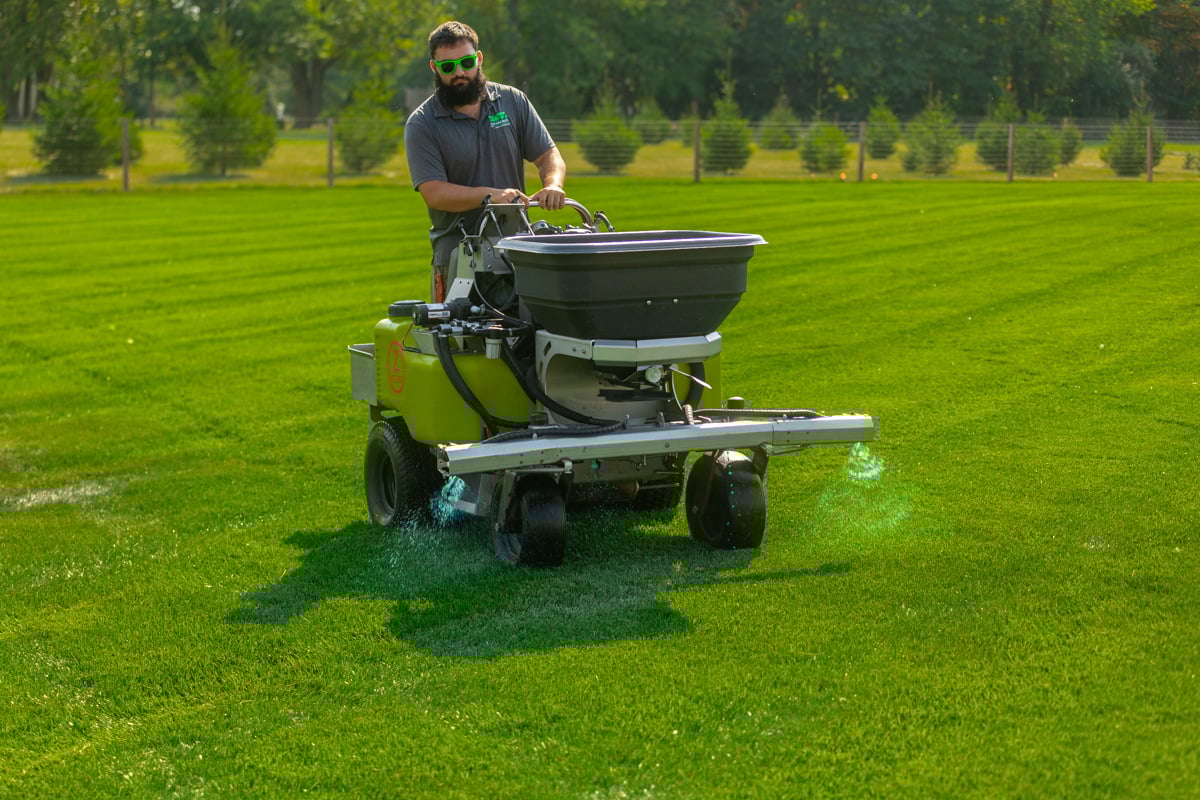
It’s important to understand that micronutrients do not replace primary nutrients. But they are an important supplement that can lead to improved lawn health.
Micronutrients support lawns by helping them to perform essential tasks like chlorophyll production, root growth, and nutrient uptake. Different micronutrients have different purposes.
For instance, iron can help grass to produce chlorophyll and stay green, manganese supports photosynthesis, and zinc is important for overall healthy growth.
For most lawns, soil testing is the best way to determine whether you have micronutrient deficiencies.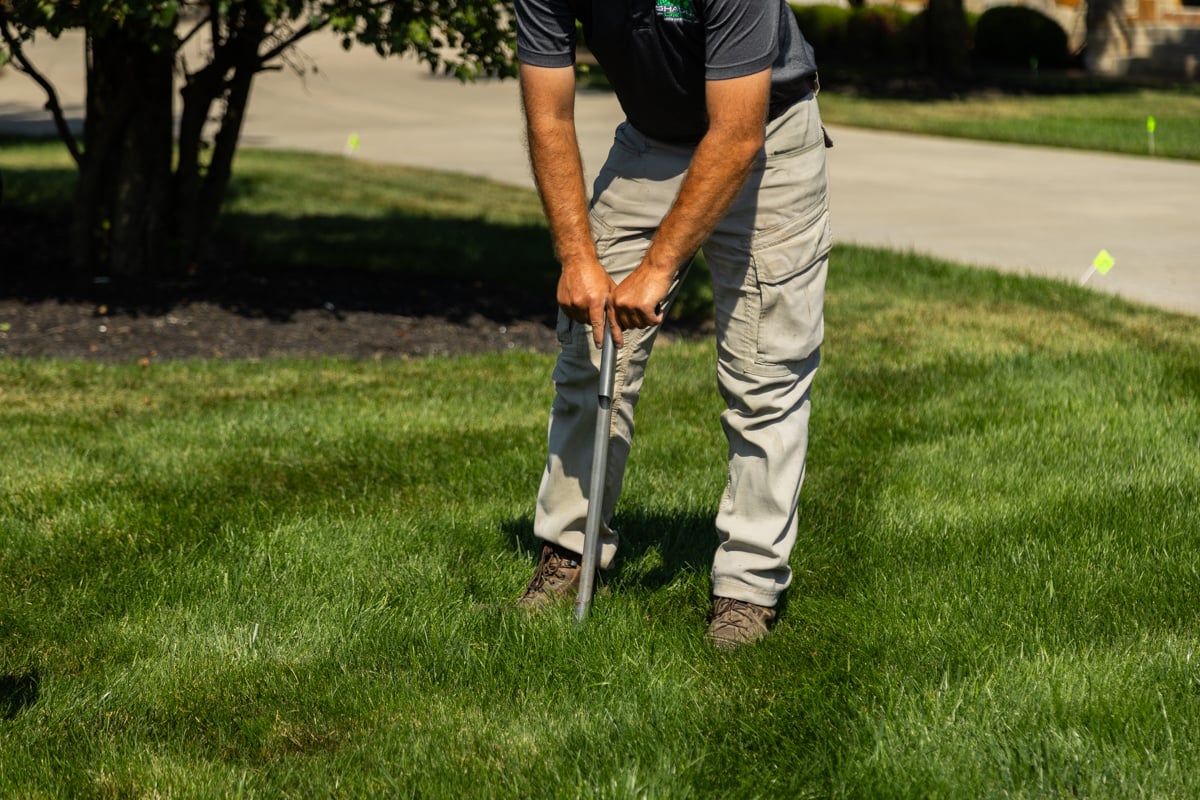
A standard soil test for lawns measures several key factors, starting with pH and cation exchange capacity (CEC). Think of CEC as your soil’s sponginess. It is your soil’s ability to hold onto nutrients and water rather than letting them pass straight through. A soil with a good CEC acts like a nutrient storage bank, making vital elements available to your grass over time.
The test also evaluates macronutrients (like phosphorus and calcium) and micronutrients (like iron and zinc). You won’t see nitrogen or potassium levels included, since they are mobile nutrients that leach out of the soil too quickly to measure accurately. Instead, soil testing focuses on nutrients that reveal long-term imbalances or deficiencies.
Most lawn care companies are not getting to this in-depth level of what a lawn truly needs to thrive. They’re sticking to the basics (nitrogen, phosphorus, and potassium) and calling it a day.
And lawns will do OK like this. They’re not going to die, but they’re also not going to thrive. There are a lot of puzzle pieces missing when you take a basic approach.
For instance, most lawns in Indiana need sulfur to lower pH, not lime to raise it. Ammonium sulfate fertilizer works great because it contains more sulfur than nitrogen, helping to unlock bound-up micronutrients so your grass can use them. But here’s the catch - most companies don’t use it because it is more expensive.
That’s the benefit of choosing a company that is focused on science-based lawn care and supplying the lawn with what it actually needs.
At Shades of Green, we use a micronutrient fertilizer for lawns applied through foliar applications, which means spraying them directly onto grass leaves. This method of application allows the plants to take the nutrients into the leaf tissue directly.
This can help us to avoid some soil limitations. Absorption is often hindered by high pH levels, so we bypass that issue. This can also give a faster response time in many cases.
It depends on the micronutrient, what level of deficiency your lawn is experiencing, and how it is applied. Foliar applications do generally work faster than soil applications.
While the timing can depend on the micronutrient, the fall and the spring are generally the best times of year for these applications. In general, our lawn care applications are strategically spaced over 7 treatments from March to November. Our micronutrient applications are carefully timed within that window.
Yes, too much iron, or too much of other micronutrients, can damage grass. This is why it’s so important that these are applied properly. Excessive iron can lead to leaf burn. With applications, it’s important to remember that “more” does not automatically mean “better.” The same is truly for lawn fertilization in general.
The biggest concern for newly seeded lawns is proper moisture and good seed-to-soil contact. But in time, paying attention to soil health will be critical.
When it comes to finding lawn care in Lafayette and nearby areas, you want to find a company that uses science-backed methods and that focuses on soil health.
Soil health is the foundation of a vibrant, healthy lawn, and it is often the piece that is overlooked when lawns struggle. Compacted soil, nutrient imbalances, and depleted microbial life can make it difficult for even the most diligent lawn care routine to produce the results you want.
At Shades of Green, we offer lawn care in Lafayette, Carmel, Noblesville, Westfield, Zionsville, and the surrounding area. With years of experience assessing Indiana soils, targeted soil treatments, and carefully timed programs like our Spring and Fall Soil Builders, we help your lawn build strength from the soil up. By addressing the true causes of poor growth, your struggling turf can bounce back.
Our micronutrient package is important as Indiana soils often have a pH between 7 and 8.3, which can lock out essential micronutrients even if they are present in the soil. Our program applies these nutrients directly to the grass blades, allowing your lawn to absorb them through the leaves rather than the roots. This ensures your grass gets what it needs for a deeper green, healthier lawn, regardless of soil pH.
When homeowners get frustrated with their lawns, the issue is often solvable issues that are taking place at the subsurface level. But many lawn care providers simply don’t get this in-depth and dig into what’s truly going on. Again, this is the value of choosing a science-based program.
If your lawn isn’t living up to its potential, it might be time to focus on what is beneath the surface. We’re here and ready to help! Get started on soil repair today by filling out our contact form.
Envision a Brighter Future for Your Lawn


Cory is the heart and soul of Shades of Green. His dedication to doing right for our customers has been the driving force behind the company's success. With a degree in Turf Science from Purdue University, Cory continually strives to craft the best treatment plans using the latest technologies and innovative products, ensuring top-notch results for every client.